Darkness Lord Byron Did It Become Light Again?
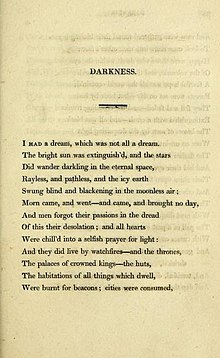
"Darkness" is a poem written by Lord Byron in July 1816 on the theme of an apocalyptic end of the world which was published as office of the 1816 The Prisoner of Chillon collection.
The year 1816 was known as the Year Without a Summertime, because Mount Tambora had erupted in the Dutch East Indies the previous year, casting enough sulphur into the temper to reduce global temperatures and cause aberrant weather condition across much of n-east America and northern Europe. This curtain of darkness inspired Byron to write his poem.
Literary critics were initially content to classify it as a "last man" poem, telling the apocalyptic story of the last homo on globe. More recent critics have focused on the poem'south historical context, also as the anti-biblical nature of the poem, despite its many references to the Bible. The poem was written just months subsequently the end of Byron's marriage to Anne Isabella Milbanke.
Historical context [edit]

A diagram of the estimated ash fallout from the 1815 Mount Tambora eruption. Ash clouds travelled much farther.
Byron's poem was written during the Romantic menstruum. During this menstruum, several events occurred which resembled (to some) the biblical signs of the apocalypse. Many authors at the time saw themselves as prophets with a duty to warn others about their impending doom.[1] Notwithstanding, at the same time menses, many were questioning their faith in a loving God, due to contempo fossil discoveries revealing records of the deaths of entire species buried in the earth.[2]
1816, the year in which the poem was written, was called "the yr without a summer", as strange weather and an inexplicable darkness caused record-cold temperatures across Europe, specially in Geneva.[iii] Byron claimed to have received his inspiration for the poem, saying he "wrote it... at Geneva, when there was a celebrated dark solar day, on which the fowls went to roost at noon, and the candles were lighted equally at midnight".[4] The darkness was (unknown to those of the time) caused past the volcanic ash spewing from the eruption of Mountain Tambora in Republic of indonesia (Vail 184). The search for a cause of the strange changes in the light of mean solar day only grew as scientists discovered sunspots on the sun so big that they could exist seen with the naked eye.[5] Newspapers such as the London Chronicle reported on the panic:
The big spots which may now be seen upon the sun's disk have given ascent to ridiculous apprehensions and cool predictions. These spots are said to be the cause of the remarkable and wet atmospheric condition we take had this Summertime; and the increase of these spots is represented to announce a general removal of heat from the world, the extinction of nature, and the end of the world.[6]
A scientist in Italy even predicted that the dominicus would exit on 18 July,[7] shortly before Byron'south writing of "Darkness". His "prophecy" caused riots, suicides, and religious fervour all over Europe.[8] For example:
A Bath girl woke her aunt and shouted at her that the world was ending, and the adult female promptly plunged into a coma. In Liege, a huge deject in the shape of a mountain hovered over the town, causing alarm amid the "old women" who expected the end of the world on the eighteenth. In Ghent, a regiment of cavalry passing through the town during a thunderstorm blew their trumpets, causing "three-fourths of the inhabitants" to rush forth and throw themselves on their knees in the streets, thinking they had heard the seventh trumpet.[9]
This prediction, and the strange beliefs of nature at this time, stood in directly contrast with many of the feelings of the age. William Wordsworth often expresses in his writing a belief in the connection of God and nature which for much of the Romantic Era's poetry is typical. His "Tintern Abbey", for instance, says "Nature never did beguile / The heart that loved her".[x] His poetry also carries the idea that nature is a kind matter, living in peaceful co-existence with human being. He says in the same poem, referring to nature, that "all which nosotros behold / is total of blessings."[11] In other poems, such as "I Wandered Lonely as a Cloud", he uses language for flowers and clouds that is commonly used for heavenly hosts of angels.[12] Fifty-fifty the more than frightening Gothic poems of Coleridge, another famous poet of the time, fence for a kind handling of nature that is only cruel if treated cruelly, every bit in The Rime of the Ancient Mariner, different Byron's lord's day, which goes out with no man mistreatment mentioned at all.[13]
Criticism and analysis [edit]
In the past, critics classified "Darkness" as a "Last Man" verse form, following a general theme of the stop of the world scenes from the view of the last man on earth. All the same, recent scholarship has pointed out the poem'due south lack of any single "Final Man" graphic symbol.[14] At the conclusion of the poem, all the same, it is only the consciousness of the speaker that remains in a dark and desolate universe. Thus, the narrator could function as a Terminal Man character.
Biblical imagery [edit]
Byron also uses the hellish biblical language of the apocalypse to carry the real possibility of these events to his readers. The whole verse form tin exist seen as a reference to Matthew 24:29: "the dominicus shall be darkened." In line 32 information technology describes men "gnash[ing] their teeth" at the heaven, a clear biblical parallel of hell.[15] Vipers twine "themselves amid the multitude, / Hissing."[16] Two men left live of "an enormous urban center" gather "holy things" around an altar, "for an unholy usage"—to burn down them for lite. Seeing themselves in the calorie-free of the burn down, they die at the horror of seeing each other "unknowing who he was upon whose brow Famine had written Fiend."[17] In this future, all men are made to expect similar fiends, emaciated, dying with "their bones every bit tombless every bit their flesh."[eighteen] They likewise act similar fiends, as Byron says: "no love was left,"[xix] matching the biblical prophecy that at the end of the globe, "the honey of many shall wax cold."[20] In doing this, Byron is merely magnifying the events already occurring at the fourth dimension. The riots, the suicides, the fear associated with the foreign plough in the weather and the predicted destruction of the sun, had besieged not simply people's hope for a long life, but their beliefs about God's creation and well-nigh themselves besides. By bringing out this diabolical imagery, Byron is communicating that fearfulness; that "Darkness [or nature] had no demand / of aid from them—She was the universe."[21]
Byron's pessimistic views continue, as he mixes Biblical language with the apparent realities of science at the time. As Paley points out, it is non so much significant that Byron uses Biblical passages equally that he deviates from them to make a point.[22] For example, the thousand-year peace mentioned in the book of Revelation as coming after all the horror of the apocalypse does not exist in Byron's "Darkness." Instead, "War, which for a moment was no more, / Did glut himself over again."[23] In other words, swords are only browbeaten temporarily into plowshares, only to become swords of war again. Also, the fact that the vipers are "stingless"[24] parallels the Biblical paradigm of the peace to follow destruction: "And the sucking child shall play in the whole of the asp."[25] In the poem, though, the ophidian is rendered harmless, just the humans take reward of this and the vipers are "slain for nutrient." Paley continues, proverb "associations of millennial imagery are consistently invoked to be bitterly frustrated."[26]
References [edit]
- ^ Introduction, 7
- ^ Gordon 614
- ^ Paley, 2
- ^ Paley, 3
- ^ Vail, 184
- ^ qtd. in Vail 184
- ^ Vail 183
- ^ Vail 186
- ^ qtd. in Vail 186
- ^ "Darkness," ll. 122–123
- ^ qtd. in Schroeder 116
- ^ "Darkness," ll. iv
- ^ Schroeder, 116
- ^ Schroeder 117
- ^ see Matt 24:51
- ^ "Darkness," ll. 35–37
- ^ "Darkness," ll. 55–69
- ^ "Darkness," ll. 45
- ^ "Darkness," ll. 41
- ^ see Matt 24:12
- ^ "Darkness," ll. 81–82
- ^ Paley, 6
- ^ "Darkness," ll. 38–39
- ^ "Darkness," ll. 37
- ^ Paley 6
- ^ Paley, 6
Bibliography [edit]
- Gordon, George. "Darkness." The Norton Anthology of English Literature. Stephen Greenblatt. eighth ed. Vol. D. New York, London: Norton, 2006. 614-six.
- "Introduction." The Norton Anthology of English language Literature. Stephen Greenblatt. eighth ed. Vol. D. New York, London: Norton, 2006. 1–22.
- Paley, Morton D. "Envisioning Lastness: Byron's 'Darkness,' Campbell's 'the Terminal Man,' and the Disquisitional Aftermath." Romanticism: The Journal of Romantic Civilisation and Criticism 1 (1995): 1–14.
- Schroeder, Ronald A. "Byron'due south 'Darkness' and the Romantic Dis-Spiriting of Nature." Approaches to Educational activity Byron'southward Poetry. Ed. Frederick W. Shilstone. New York: Mod. Lang. Assn. of Amer, 1991. 113–119.
- Vail, Jeffrey. "'the Bright Sunday was Extinguis'd': The Bologna Prophecy and Byron's 'Darkness'." Wordsworth Circle 28: (1997) 183–92.
- Wordsworth, William. "Lines: Equanimous a Few Miles above Tintern Abbey. . ." The Norton Anthology of English Literature. Stephen Greenblatt. 8th ed. Vol. D. New York, London: Norton, 2006. 258-62.
- ---."I Wandered Lonely as a Cloud." The Norton Anthology of English Literature. Stephen Greenblatt. eighth ed. Vol. D. New York, London: Norton, 2006. 305-half-dozen.
External links [edit]
-
 Darkness public domain audiobook at LibriVox
 - The poem
Source: https://en.wikipedia.org/wiki/Darkness_%28poem%29
0 Response to "Darkness Lord Byron Did It Become Light Again?"
Post a Comment